
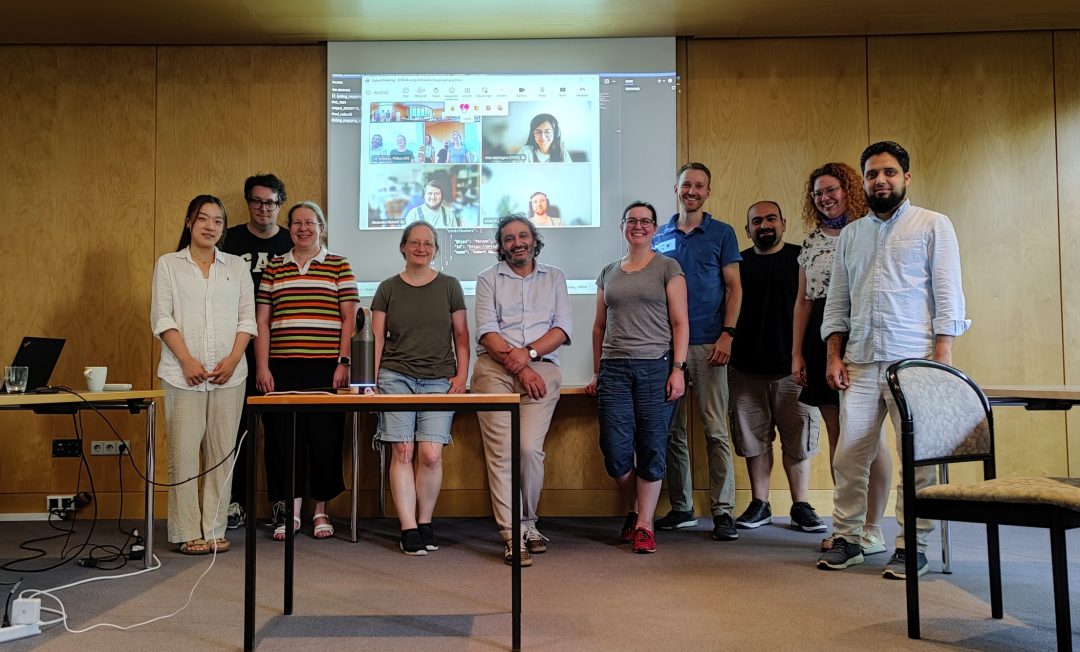
On July 16–17, 2026, our NFDI4Energy team (Measure 4.3) hosted a Metadata Mapping Hackathon in Karlsruhe, which turned out as two days of great collaboration and progress!
In the workshop 13 participants from eight institutions participated. The participants represented the institutions OFFIS – Institute for Information Technology, TIB Leibniz Information Centre for Science and Technology – University Library, Reiner Lemoine Institut, Karlsruhe Institute of Technology (KIT), FIZ Karlsruhe – Leibniz Institute for Information Infrastructure, Albert-Ludwigs-University Freiburg, German Aerospace Center (DLR), and the University of Stuttgart) joined by 4 guests from outside NFDI4Energy: Two from the Helmholtz Metadata Collaboration (HMC), from NFDI4Culture, and NFDI4ING.
Together, while sharing tons of great discussions, the participants built:
- 597 lines of code
- 198 lines of mappings
- 162 lines of tests
- 7 sample data sets + 6 manually transformed metadata records
- 537 lines of documentation
The chosen approach for Metadata Record Transformation uses Graph transformations in RDF as this was seen as a trusted and mature technology. The process breaks down into three major steps:
- Lifting input data from various formats into an RDF representation
- Graph-based transformation of the metadata record using SHACL Rules
- Lowering the result graph into the target format
Semantic mappings are currently required as SHACL Rules.
Takeaways & open challenges:
- Mapping creation is hard and needs a good understanding of SHACL and SPARQL -> A human layer would be helpful either as a more accessible mapping format or a visual mapping builder
- Code, Mappings, and Demo Datasets need to be put together to create proper Test cases
- Lowering into the target format is challenging as structural information gets lost in RDF (several ideas need to be evaluated further)
A follow-up meeting is planned for September to review open tasks and plan next steps.
Thanks to everyone who joined and contributed to this productive event!
And special thanks to Measure 4.3 for the great initiative of planning and conducting the event!